She’s five and speaks four languages
Five-year-old Linda speaks Turkish with her mother, Swedish with her father, Finnish at preschool and English with the whole family.
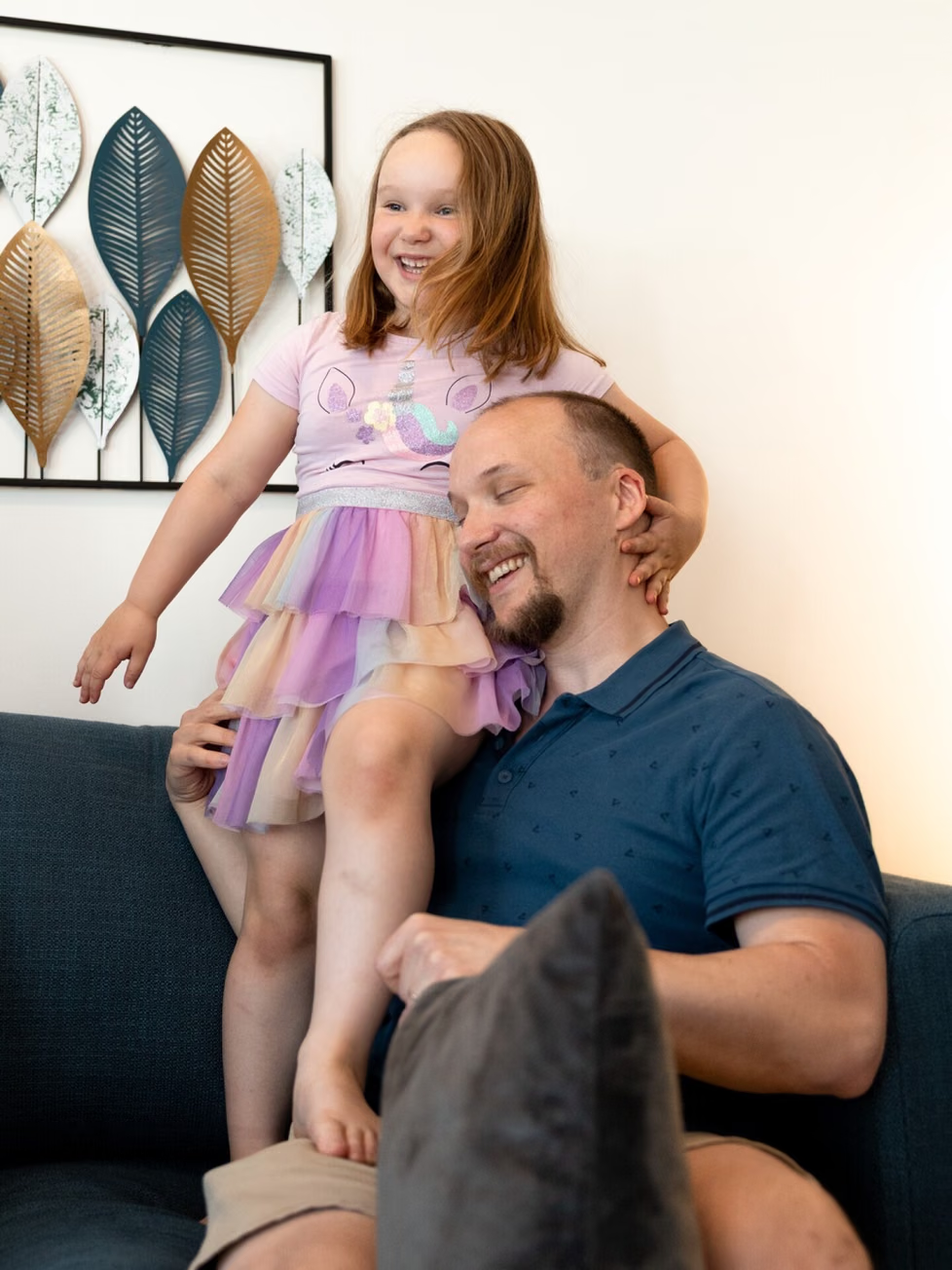
Linda Holopainen, 5, is her family’s language whiz. Her mother, Hande Demir Holopainen, is from Turkey, and her father, Ville Holopainen, has his roots in Ostrobothnia. Photo: Anton Kunnas / HS
Marilla Parhiala HS
Originally published by Helsingin Sanomat Gazette translated this article into English from the Finnish original. Read how we choose and translate stories in How we work.
“I would have liked Linda to have the same experience too”
Four languages are spoken in the Holopainens’ family of three.
Linda Holopainen, 5, speaks four languages. She has the broadest language repertoire in her family.
She speaks Turkish to her mother, Hande Demir Holopainen; Swedish to her father, Ville Holopainen; and Finnish at preschool. The family’s shared language is English.
With four languages in the family, the parents have had to make difficult choices.
Early in the relationship, Hande thought Finnish could be the family’s shared language. She assumed she would have learned it by the time having children was on the agenda.
That didn’t happen. Hande understands Finnish, but she mostly uses English at work and at home. Her Finnish hasn’t grown stronger as quickly as she had hoped.
The couple now understand each other’s native languages quite well, but changing their shared language after many years would feel strange.
At first, Hande spoke English to Linda too. She soon realized that unless she spoke Turkish to her daughter systematically, Linda would not learn the language at all. How would the girl be able to chat with her grandparents then?
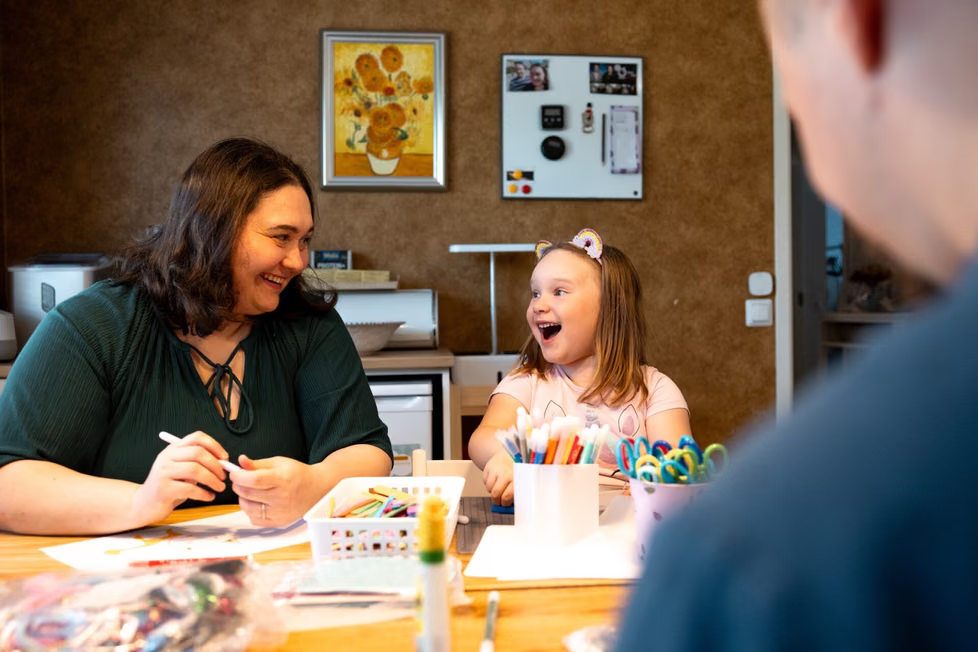
Hande Demir Holopainen and Linda enjoy doing crafts together. At home, the mother tries to make sure Turkish stays part of her daughter’s everyday life. Photo: Anton Kunnas / HS
Ville has spoken Swedish to Linda from the start. He grew up speaking Swedish to his mother and Finnish to his father at home. Ville went to school in Swedish, and he does consider the Finland-Swedish community his own.
Originally, the parents planned to send Linda to a Swedish-language school. And Linda did go to a Swedish-language daycare in Espoo.
Then the family moved to Kerava.
Kerava has only one Swedish-language daycare and elementary school, and both are quite far from the family’s home. Middle school would have meant going to Vantaa or Sipoo.
The parents decided to put Linda in a Finnish-language daycare. Hande thought it would help Linda learn the fourth language. Finnish was perhaps the weakest of Linda’s languages.
At first, Linda spoke Swedish to the caregivers, but after just a week she had already switched to Finnish. These days, Linda sometimes uses Finnish words even at home.
Ville’s roots are in Ostrobothnia. He had hoped that Linda would become part of the Swedish-language school world and the Finland-Swedish community the same way he did.
“I would have liked Linda to have the same experience.”
Even so, both parents agree that choosing Finnish as Linda’s school language is certainly the best decision.
They believe Linda will end up with four strong languages.
Still, the broad language repertoire is also a cause for concern. A child growing up in multilingual surroundings may learn many different languages but, in the end, none of them quite perfectly.
“That’s the risk here, of course,” Hande admits.
“Mom, I think I’m Finnish”
Aida Särkkä, 6, is growing up surrounded by three languages and two cultures.
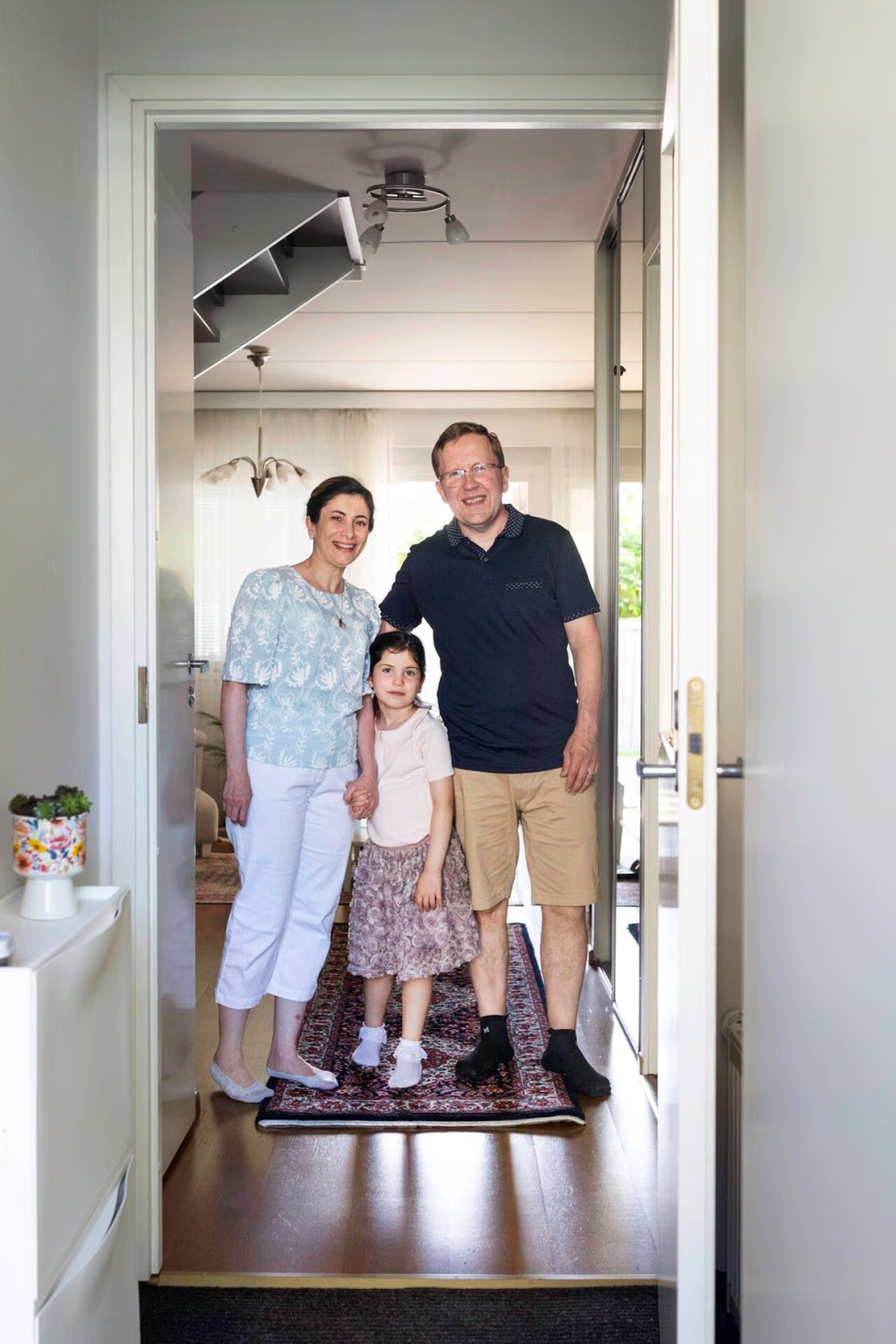
Aida Särkkä with her parents, Shila Jafari and Heikki Särkkä, at home in Espoo. In the family, Finnish and Iranian traditions meet. Photo: Sami Kero / HS
Aida Särkkä was 3 when she began thinking about her own roots. Her father was Finnish, and she and her mother were Iranian. That was how Aida understood it at the time.
But a couple of months ago, Aida, now 6, changed her mind.
“She said to me, ‘Mom, I think I’m Finnish,’” Shila Jafari says.
Shila said that of course Aida is Finnish. Aida is growing up in Finland, eats Finnish food and plays with Finnish children. At the same time, the family tries to nurture Iranian culture, traditions and celebrations, and of course Shila’s native language too.
Shila is from Iran. She speaks Farsi to her daughter, while Aida’s father, Heikki Särkkä, uses Finnish. Between themselves, the parents mostly speak English, which Aida also uses at her daycare.
Shila remembers that before she got married, the idea of a relationship with someone who didn’t share her native language scared her. Would she be able to express her feelings some other way, or in some other language?
“When I was expecting Aida, I worried: what if the child didn’t have the capacity to learn my native language? That could have been challenging.”
However, Aida has learned to use all three languages fluently.
Shila isn’t sure whether Aida’s language skills are down to the family’s systematic use of the three languages or to the child’s personality. Aida is really interested in learning words in new languages, after all, Shila says.
“I’m a little afraid that when Aida learns Swedish at school, father and daughter will have a secret language of their own,” Shila jokes.
One of Shila’s sisters lives and studies in Finland. In true Finnish fashion, Aida calls her “täti,” or aunt. The rest of the family is still in Iran, but as long as the internet connection holds, they stay close through messages and video calls.
Aida’s language skills amaze her relatives, Shila says proudly. Aida knows many dialect words and also likes to joke in Farsi.
She can do dialects in Finnish too. Heikki is from Mikkeli. While visiting relatives, Aida has learned a little of the Savo dialect.
“Just say it in English”
In the El-Khatib family, English makes everyday life easier, but the children’s Arabic has grown weaker.
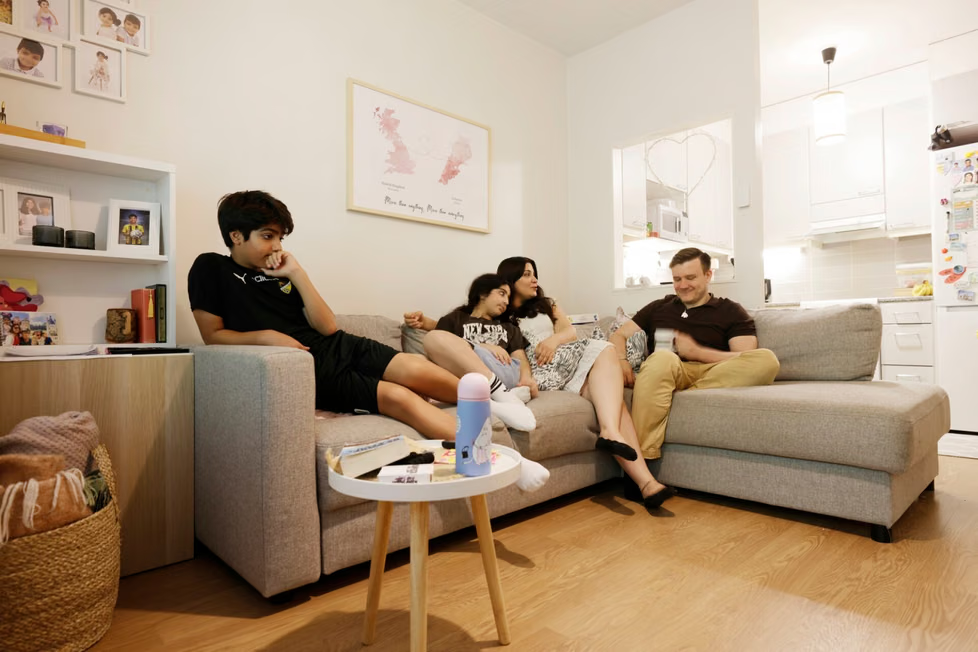
The El-Khatibs’ blended family on their sofa at home in Espoo. The father, Henri Ashurst El-Khatib, is from Britain, and the mother, Layal El-Khatib, moved to Finland from Lebanon as a child. On the left are the children, Adam and Lilia. Photo: Liisa Takala
Henri Ashurst El-Khatib has an impatient audience. When he tries to speak Finnish to the family’s children, finding the words and putting a sentence together take time. Lilia, 10, and Adam, 12, don’t always have the patience to wait.
“They tell me, ‘Just say it in English.’”
Henri is British, and English is his native language. His spouse Layal El-Khatib’s children are from an earlier relationship. When Henri became part of the family, English ended up as their shared language.
Layal, for her part, speaks mostly Finnish to her children. It is one of her native languages, since she moved from Lebanon to Finland as a child. Layal’s other native language is Arabic.
According to Layal, Henri’s problem is that he clings too much to correct grammar. You should have the courage to speak, even if mistakes happen now and then.
That is difficult for Henri. He pronounces Finnish convincingly, but learning the 15 grammatical cases and using them fluently takes exceptional dedication, he says. That is why he doesn’t use the language in his everyday life as much as he perhaps should.
In Henri’s view, Finnish is the most challenging language he has studied. That is saying a lot, because he also speaks Mandarin Chinese, Cantonese, Welsh, French and Spanish. And some German, Turkish, Arabic and Uyghur.
“I wouldn’t say Finnish is a difficult language. If you think of something as difficult, you put up a mental barrier for yourself. That’s why I call it challenging.”
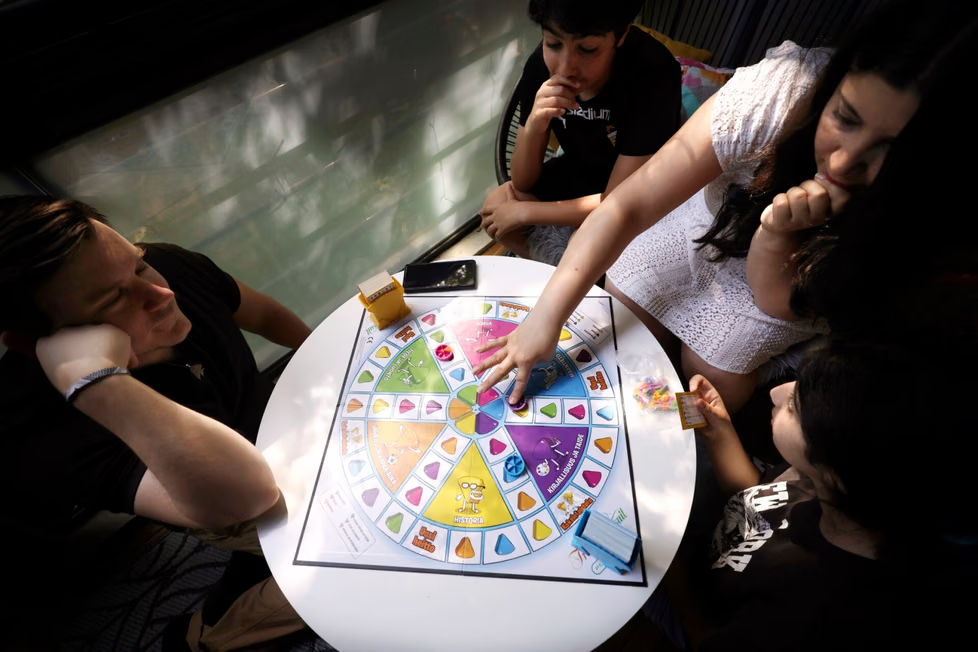
The El-Khatib family plays Trivial Pursuit in Finnish. Photo: Liisa Takala
Adam and Lilia were born in Finland. When they were little, Layal spoke Arabic to them. Back then, their language skills were quite good, Layal reflects.
After they started school, the children began speaking Finnish at home too, and Layal didn’t think much about it. It felt natural to answer in Finnish when the children spoke Finnish to her.
These days, hardly any Arabic is spoken at home. The children go to a language club every week so that they keep at least some of the skill. They understand Arabic well but use it only occasionally.
If Layal gets angry, though, the language may still switch to Arabic. You can put more emotion into it. Ranting in Arabic feels more satisfying than in Finnish, Layal says. Arabic is good for giving the children orders, too.
“The message gets through right away. If I give them orders in Arabic, they get going immediately.”
In hindsight, Layal has wondered whether she should have consistently spoken only Arabic to the children at home.
But the past can’t be changed.
Spotted a mistake or something unclear in this article? Write to us about it at antti.karvanen@sanoma.com.